MOSWOC high energy electron forecast for geostationary orbit
Forecaster summary - Issued 2020-08-05T12:10:51
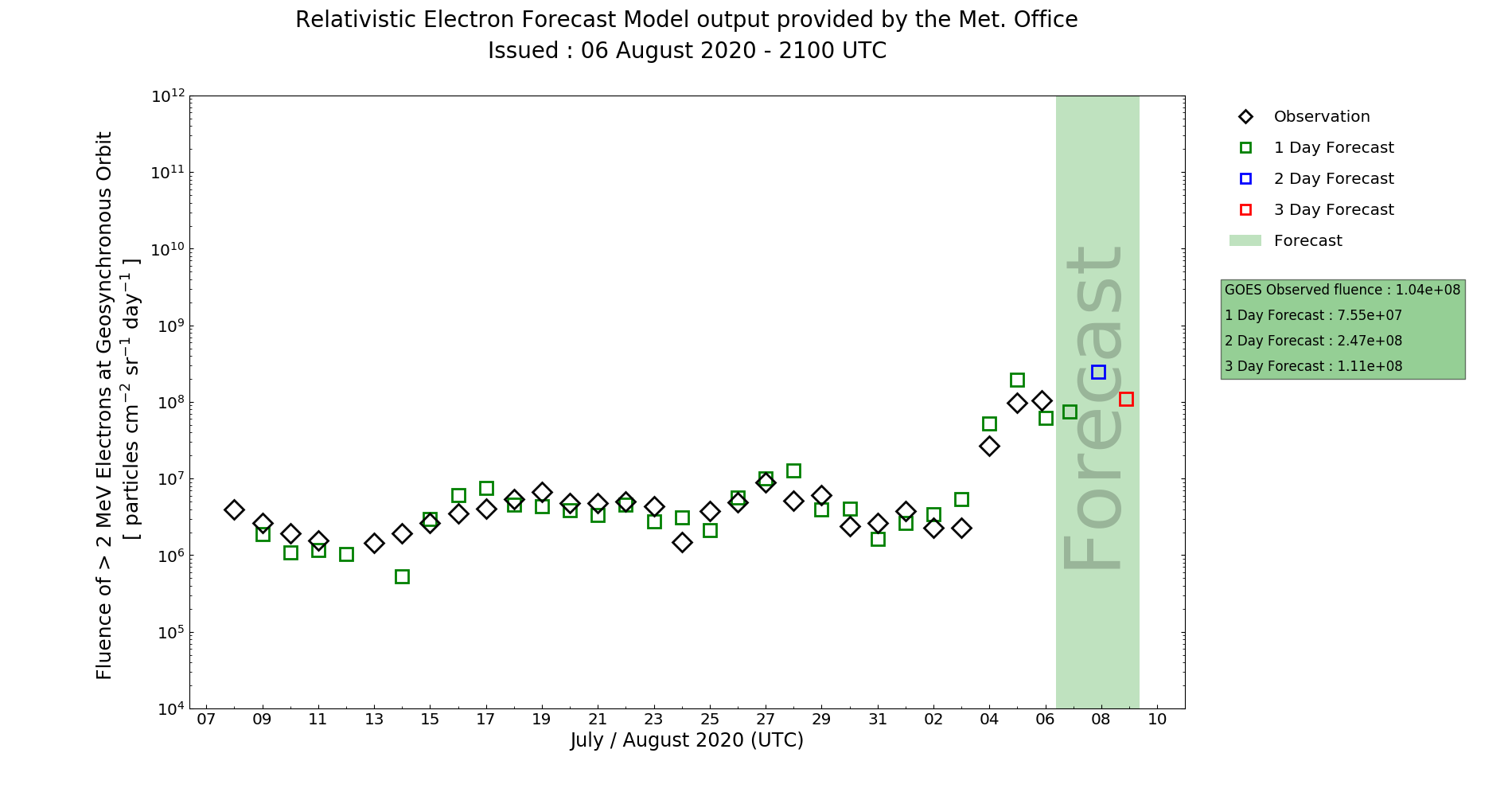
The high energy electron flux (greater than 2MeV) has reached high levels today, and will decline back to moderate overnight. It is expected to continue to reach high levels during the diurnal maximum over the next 4 days. There is likely to have been a significant input of electrons into the radiation belts with the high speed stream from CH64, but the fast solar wind may be compressing the belts away from the orbit of GOES-16 at GEO. As the solar wind declines the flux observations are expected to show a marked uplift, and recent observations are showing this.
In the presence of increasing flux, the corresponding 24 hour electron fluence values are expected to rise sharply, with an increasing likelihood of reaching or exceeding the Active (1e8 integrated pfu) threshold, most likely from Day 2 (06 Aug). However, peak levels are uncertain. The REFM model is showing this increasing trend, although it is currently overestimating the fluence values. As such it is expected that the model is reaching the Active threshold too soon and timings should be delayed from the model guidance. As the coronal hole has developed significantly since the last rotation, the recurrence-persistence model is not expected to provide good guidance and consequently it is showing only a very low chance of reaching Active levels.
| High Energy Electron Event Forecast | ||
|---|---|---|
| Issued 2020-08-05T12:10:51 | ||
| Probability of threshold exceedance | ||
| Active | V.Active | |
| Day 1 | 30% | 1% |
| Day 2 | 60% | 1% |
| Day 3 | 80% | 1% |
| Day 4 | 80% | 1% |