MOSWOC high energy electron forecast for geostationary orbit
Forecaster summary - Issued 2020-03-08T00:05:34
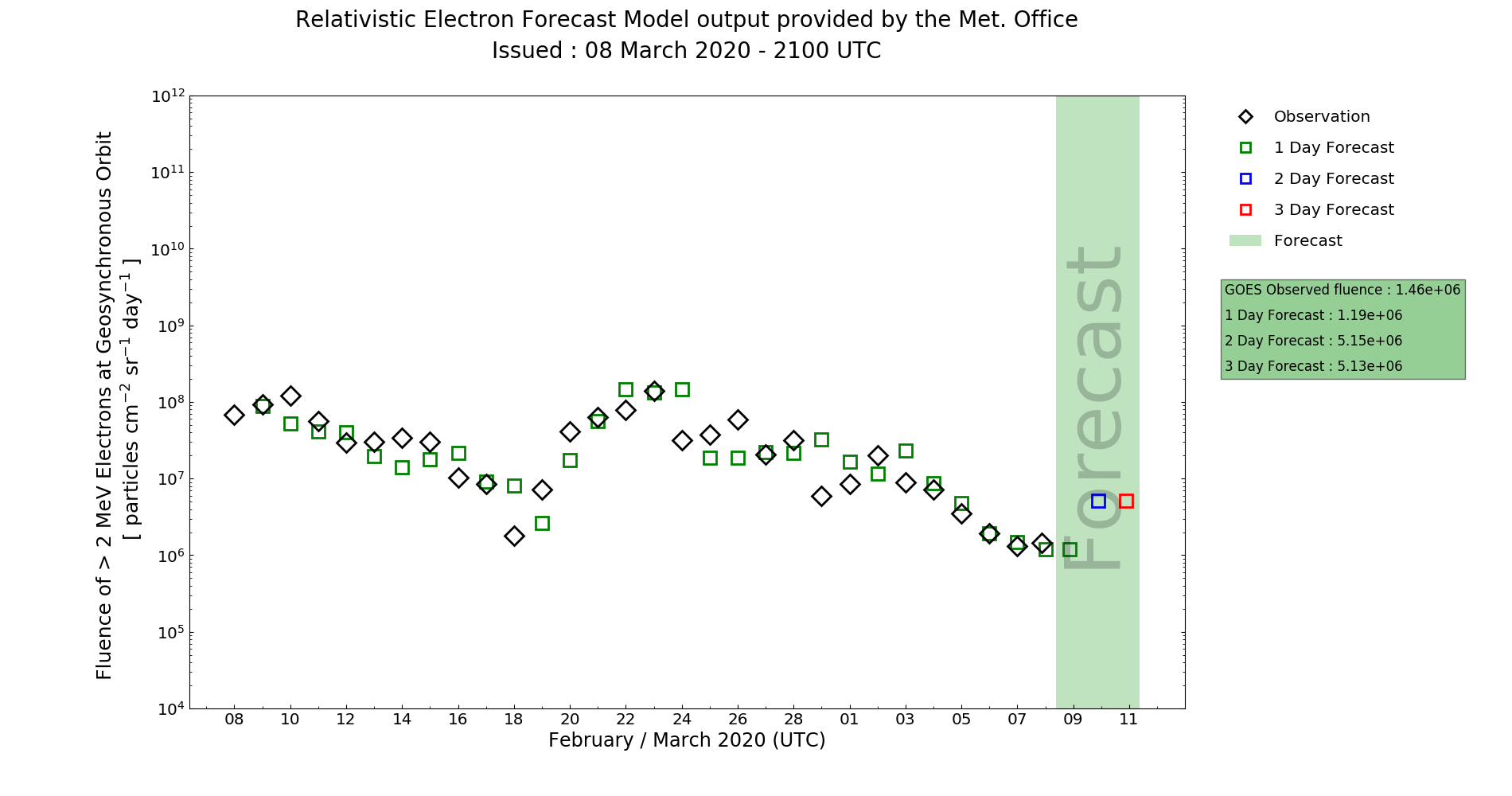
The high-energy (greater than 2MeV) electron forecast carries lower than average confidence. Persistence methods are not favoured for reasons discussed in the geomagnetic section, and hence REFM and other models are less useful. Increases in flux rely on low confidence events: a glance from a CME initially, and then a slightly more assured connection with CH20 into the new working week. It should be noted that there is therefore a distinct possibility that the current Normal Background diurnal oscillation continues unaffected throughout.
A response in flux from any CME arrival should begin to show in rising integrated fluence later on day one and into day two (Sunday 08 into Monday 09 March), giving a first peak in risk on Monday ahead of any entry into CH20. Geomagnetism arising from CH20 may then temporarily disrupt this pattern before a second stronger peak in risk develops around midweek.
The slow transit speed of the CME and a rough speed of 500ish km/s for CH20 (based on recent glances from extensions of the southern polar coronal hole) mean that if the Active 24-hour fluence threshold is exceeded at all, it is likely to be marginal.
Relative to recent forecasts, the magnitude of risk of Active fluence is reduced. The rationale being that any arriving CME is now late, and slower features tend to be less impactful - if even present.
| High Energy Electron Event Forecast | ||
|---|---|---|
| Issued 2020-03-08T00:05:34 | ||
| Probability of threshold exceedance | ||
| Active | V.Active | |
| Day 1 | 5% | 1% |
| Day 2 | 15% | 1% |
| Day 3 | 10% | 1% |
| Day 4 | 30% | 1% |