MOSWOC high energy electron forecast for geostationary orbit
Forecaster summary - Issued 2020-03-04T00:29:30
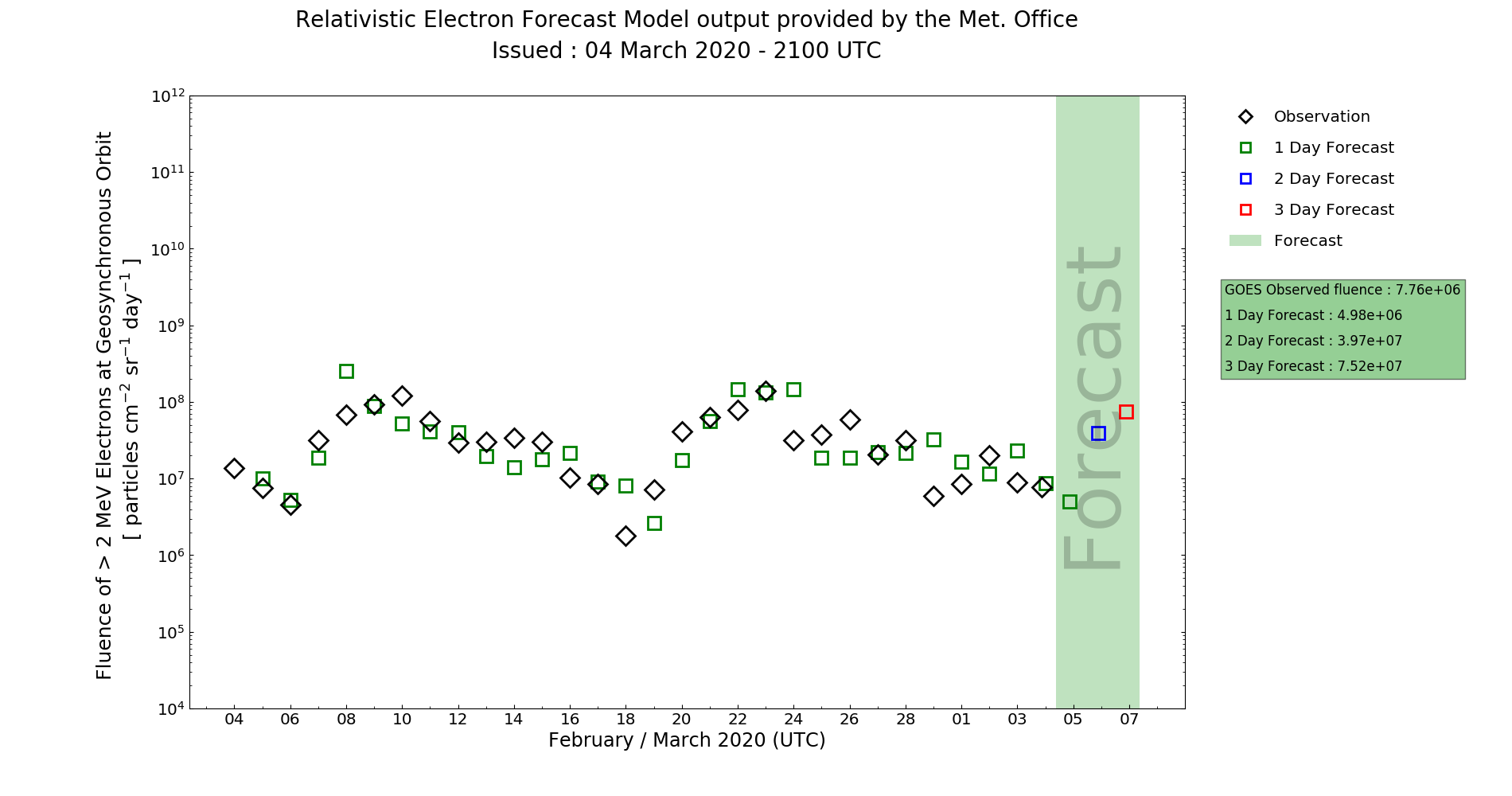
The high energy (greater than 2 MeV) electron flux as measured by GOES-16, is currently varying between background and moderate levels. Whilst likely to stay around this level through the period, there are couple of notable sources of uncertainty.
There is currently a weak CME that was anticipated to most likely arrive on the 3rd, and whilst this has yet to be observed, there is still the potential for arrival on the 4th (day 1). There is also a further weak CME that has the potential to move across the Earth either late day 3 (6th) on day 4 (7th). These could lead to enhanced flux once any initial geomagnetic activity subsides. Furthermore, a northward extended lobe from the southern polar crown coronal hole could lead to an enhancement to the solar wind pressure, increasing flux levels, most likely day 4. This feature however is lagging behind its location on the previous rotation, however, which limits the value of models that use the 27 day persistence, including REFM beyond 24 hours which has an enhancement occurring much too soon.
There is a slight chance of the flux alert threshold to be reach at peak times on each day, however the extent and longevity of any enhancement, as well as the timing are very low confidence. This means that Active fluence levels are currently not anticipated through the period, but there will be a very slight chance of reaching these levels throughout, if any significant enhancement occurs.
| High Energy Electron Event Forecast | ||
|---|---|---|
| Issued 2020-03-04T00:29:30 | ||
| Probability of threshold exceedance | ||
| Active | V.Active | |
| Day 1 | 5% | 1% |
| Day 2 | 5% | 1% |
| Day 3 | 5% | 1% |
| Day 4 | 20% | 1% |