MOSWOC high energy electron forecast for geostationary orbit
Forecaster summary - Issued 2020-09-30T00:20:52
The high energy (greater than 2 MeV) electron flux, as observed by GOES-16 is currently High (above 1000 pfu), and likely to persist at this level for much of the period, although declining very gradually from day 2 (1st). Brief spells of observed values falling below this value are possible, mainly at diurnal minimum by day 4 (3rd). These high flux values were the result of a returning coronal hole, CH82, which brought periods of minor to moderate geomagnetic activity. Electron fluxes responded, and are expected to peak day 1 (30th). On the previous solar rotation, it then took 11 days from peak flux for levels to fall to be persistently below the Active threshold, and a very similar progression is possible on this occasion.
The associated 24 hour fluence is currently Active (above the 1e8 integrated pfu threshold), and is expected to remain above this threshold through the period. With peak flux expected on day 1 (30th), there is the potential for fluence values to approach, and potentially exceeded the very active threshold (1e9). Fluence values are expected to gradually decay day 2 onward, but likely staying well above Active. This is supported by both REFM and persistence from the previous rotation, although REFM is overestimating values beyond T+24 hours.
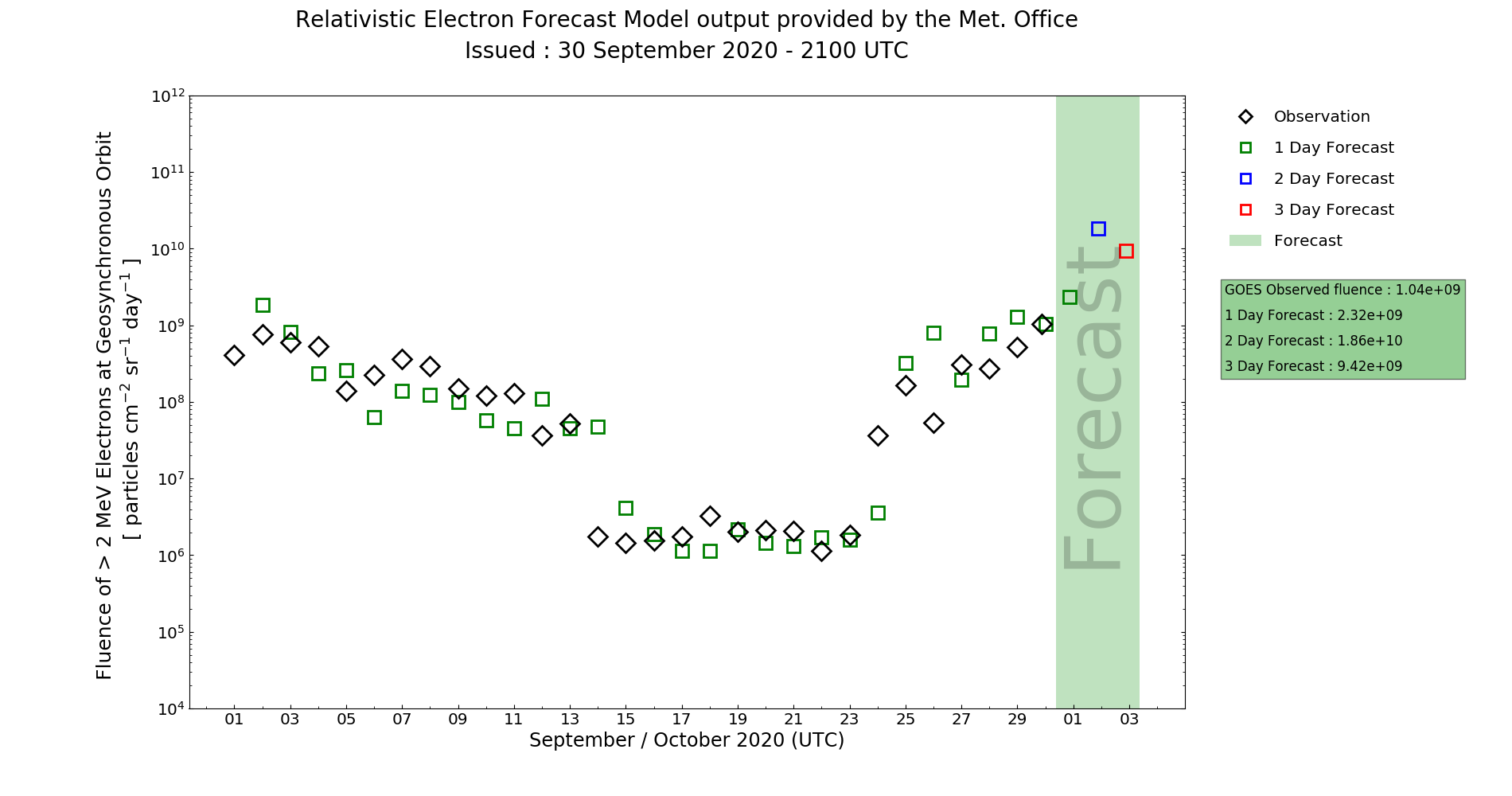
| High Energy Electron Event Forecast | ||
|---|---|---|
| Issued 2020-09-30T00:20:52 | ||
| Probability of threshold exceedance | ||
| Active | V.Active | |
| Day 1 | 100% | 40% |
| Day 2 | 99% | 40% |
| Day 3 | 95% | 10% |
| Day 4 | 95% | 5% |