MOSWOC high energy electron forecast for geostationary orbit
Forecaster summary - Issued 2025-03-11T13:06:37
The high-energy electron flux (>2MeV) observed at GOES16 reached high levels on 10 Mar at the diurnal maximum, as solar winds are now easing from the recent fast wind connection. Electron flux has become high already on Day 1 (11 Mar), and is likely to again on Day 2 (12 Mar), perhaps for longer and with a higher peak. After this, confidence is low for the longevity of this high flux due to the potential fast wind from CH22/- expected on Days 3 and 4 (13-14 Mar), along with the very slight chance of a CME glance early on Day 1 (11 Mar), providing the potential for drop out of the observed flux at GEO. Once the next fast wind is established however, there is a renewed risk of high flux levels later in the period, although this is more likely after the end of this period.
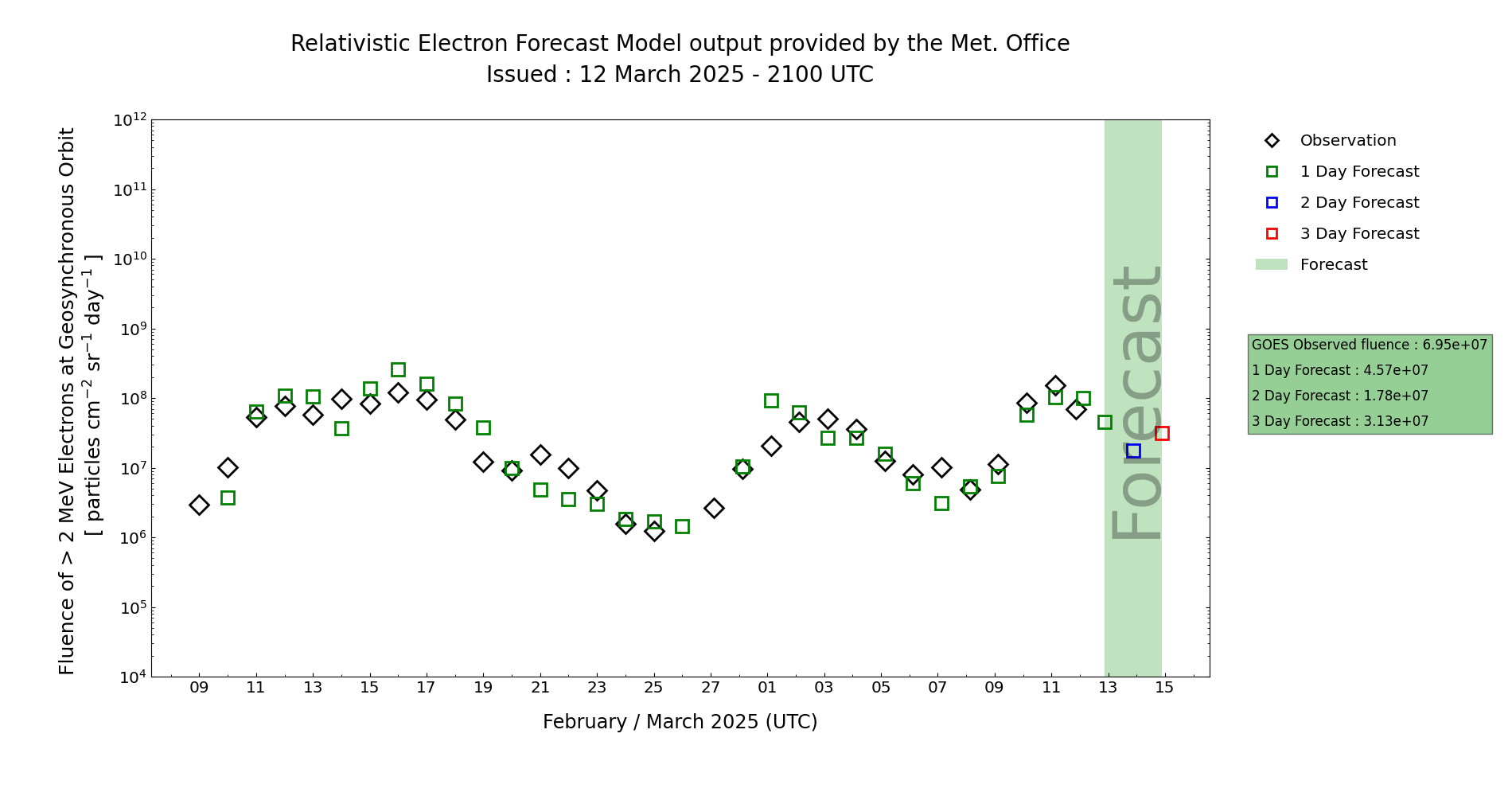
The associated 24 hour integrated fluence is currently rising and rose above the Active (1e8 integrated pfu) threshold at 11/1200 UTC, and is expected to remain above through Days 1 and 2, before potentially showing a declining trend into Days 3 and 4. Both 27-day recurrence and MOSWOC REFM are currently giving reasonable guidance for the rising trend, although this is perhaps underestimating the time spent above the active fluence threshold.
| High Energy Electron Event Forecast | ||
|---|---|---|
| Issued 2025-03-11T13:06:37 | ||
| Probability of threshold exceedance | ||
| Active | V.Active | |
| Day 1 | 100% | 1% |
| Day 2 | 80% | 1% |
| Day 3 | 60% | 1% |
| Day 4 | 40% | 1% |